

The story of an exceptional residence at the entrance of Marseille’s Old Port
Those who know it often speak of it as an unattainable dream, one of the most beautiful houses in Marseille, built right at the water’s edge, with a third of its surface suspended above the sea, in the last cove at the exit of the Old Port. To shield it from prying eyes, it is surrounded by a tall fence and a vast, lush garden.
Beyond the admiration it inspires and the truly unique site on which it stands, Casa Delauze is above all a nest. The cocoon of a family certainly unlike any other, yet one that lived there as simply as anyone else, enjoying on a daily basis the immense privilege of being able to live in such a place.
First, there is love
This exceptional house in an exceptional setting belonged to an equally exceptional couple: Henri-Germain Delauze, founder and president of Comex, and his wife Andrée Pham Van, whom he affectionately nicknamed Philbée. Together, they spent the last thirty years of their lives here, watching their children grow and weathering the ups and downs of company life—its successes as well as its challenges. A company they founded together in October 1961, just under ten years after meeting at a private gathering in Saint-Raphaël.
Love at first sight is immediate and overwhelming. It would last their entire lives and be expressed even in the affectionate nicknames they gave each other. For Andrée, Henri became Hugues, and for Henri, the beautiful Andrée became Philbée. These names eventually became commonly used by family and close friends, and the two lovers would keep them, once again, until the very last moments of their lives.
The two lovebirds married at the end of 1952, after Henri prematurely ended his first engineering contract in Africa to return to Marseille and reunite with his beloved. Armed with his degree from the École Nationale Supérieure des Arts & Métiers in Aix-en-Provence, obtained in 1949 at just twenty years old (1), he easily found work again after getting married.

In January 1953, he joined Spiros, a company manufacturing compressors and high-pressure industrial gas and air systems. At the time, he was already passionate about a discipline that had until then been reserved for a small elite: scuba diving. Indeed, in the early 1950s, a major innovation had just emerged. Developed during the war years by a young naval officer then unknown, Jacques-Yves Cousteau, and a highly ingenious engineer, Émile Gagnan, the regulator that bears their names made it possible for the first time for divers to carry an air supply on their backs.
Until then, diving other than freediving required wearing a heavy diving suit supplied with air via a long hose from the surface.
As soon as he experienced this new freedom, Delauze was fascinated—utterly captivated—by the spectacle before him and by the ease with which he could move through the liquid element using this machine


In 1951, the latter came to Marseille for the first time with his new exploration vessel, La Calypso, a former minesweeper that he had been able to convert into an oceanographic research ship thanks to the patronage of a renowned Irish brewer, Loël Guinness, owner of the eponymous beer brand.
Beuchat introduced Delauze to Cousteau, who was looking for young divers for a major first: the underwater archaeological excavation of a Roman shipwreck sunk near Grand Congloué, off the calanques of Marseille, in the same area where, half a century later, diver Luc Vanrell would rediscover the wreck of Antoine de Saint-Exupéry’s Lightning P-38, which disappeared at the end of July 1944—an investigation in which Henri-Germain Delauze would play an active role, as we shall see later. Young, an engineer, and a diver, he had everything to appeal to Cousteau. Everything, that is, except a very strong personality—something the man in the red cap did not always tolerate easily.
Their collaboration nevertheless lasted until 1956, with its ups and downs, and it was Delauze who ultimately cut ties after a final confrontation: the departure of La Calypso to shoot the film The Silent World without him. “The problem with Cousteau,” he often explained when questioned about the reasons for their falling-out, “is that one could only work FOR him, not WITH him.”
Although rigour and order were among his core values, Delauze could not imagine remaining indefinitely in a subordinate role, in keeping with the old principle that you do not make two crocodiles swim in the same marsh.

…then came success…
In 1956, he therefore accepted a position with Grands Travaux de Marseille (GTM), which had just secured a contract to build an immersed road tunnel in the Bay of Havana, Cuba.
At just 26 years old, Delauze found himself leading a team of several dozen divers, made up of a few seasoned professionals from Marseille and young Cubans recruited and trained on site to assemble, underwater, the five concrete caissons that would form the tunnel. This project was a world first at the time, and the success of the operation immediately reflected on the young leader. It was 1958. Henri, Philbée, and their daughter Michèle then returned to France. But very quickly, the gloom of Paris weighed on them. It was therefore with great enthusiasm that, during the summer, Henri received one of those offers that cannot be refused in a career—especially at its beginning. Having heard of his Cuban achievements, the U.S. State Department—the equivalent of France’s Ministry of Foreign Affairs—offered him the opportunity to study in the United States, in the field of his choice, at the university of his choice, at Washington’s expense and with the addition of a generous stipend. He chose Berkeley, in California, and geology as his field of study. Among his professors was the younger brother of the renowned physicist Albert Einstein. The family settled into a lovely house in La Jolla, near San Francisco, and enjoyed two years of happiness, dreams, and carefree living.
The Delauze family nevertheless returned to France two years later. Not because Henri lacked professional opportunities in the United States after completing his studies, but because he was already driven by another ambition—nurtured by his past experiences and his desire for achievement: to found his own underwater construction company.

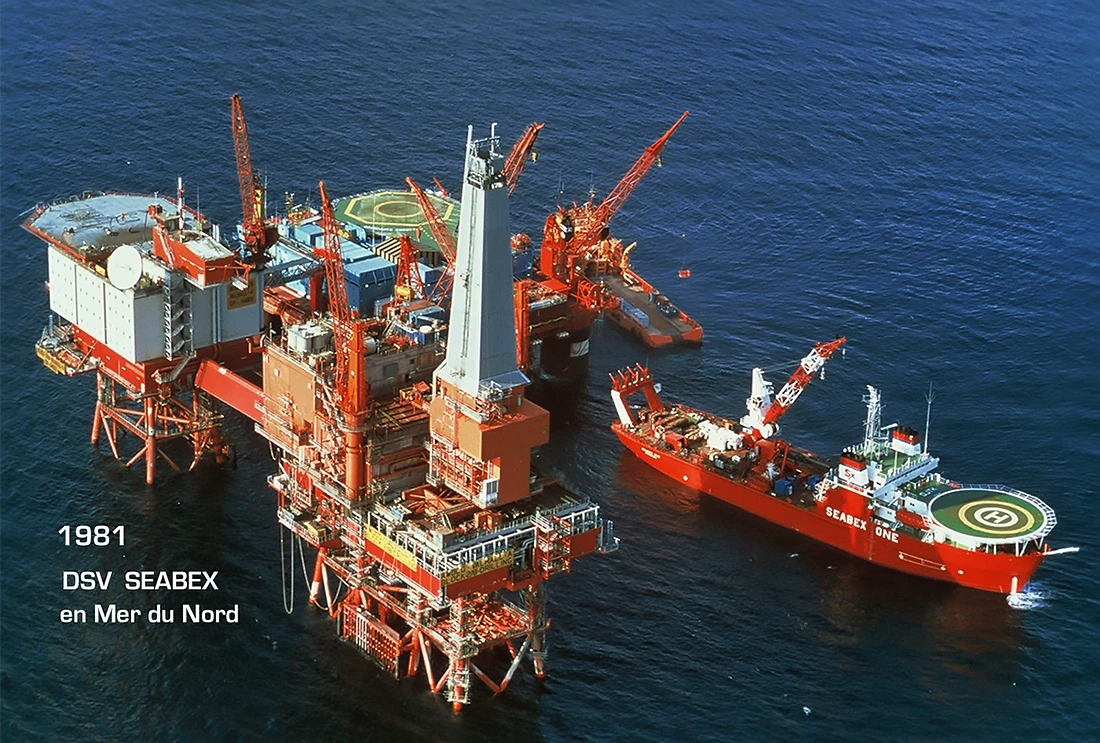
It would become the Compagnie Maritime d’Expertise, which the couple registered with the Marseille Trade and Companies Register in October 1961 and which was very quickly referred to by its acronym: Comex.
From its very first years, the company built a strong reputation and expertise in this new field, ensuring solid revenues and excellent profitability.
Very quickly, it was in the offshore oil and gas sector that Comex distinguished itself and expanded, gradually becoming a global reference. Subsidiaries were established all over the world, wherever oil was found. By 1975, Comex ranked among the top 10 French exporting companies, reporting a turnover exceeding one billion francs and employing more than 2,000 people worldwide.
In Marseille and beyond, Henri-Germain Delauze embodied the archetype of the self-made man of his time: the looks of a leading man, natural ease, formidable intelligence, business success, a perfect spouse… all that was missing was a setting worthy of this modern romance.
…and finally, consecration.
It would be Saint-Nicolas, a project that Henri and Philbée began to envision in the mid-1970s, when the couple purchased from the Terrin naval repair shipyards this magnificent 7,000-square-metre plot nestled between Fort Ganteaume, Fort Saint-Nicolas and the Pharo hill.
It would nevertheless take several years of patience and a good deal of persuasion on Henri’s part to convince the mayor, Gaston Defferre, and the various relevant authorities to grant the permits and authorisations required to build an exceptional residence and a small office building on the site. The key argument that ultimately won Defferre over was Comex’s need for a kind of secondary headquarters, where the company’s chairman and his main associates could welcome their most prestigious clients and partners in the most emblematic setting Marseille has to offer: the southern shore of the Old Port, with an unobstructed view of the two Vauban forts that guard its entrance while keeping watch over Marseille, already notorious for its turbulent character as early as the 17th century.
Confident that, sooner or later, he would bring the mayor of Marseille around to his cause, Delauze began to reflect on the outlines of his project in the months following the acquisition of the land in 1975. He turned to the Marseille-based architectural firm Delta, entrusting it with the task of designing a new complex that would meet both the company’s needs and his own expectations, for the professional as well as the private sections. Founded some twenty years earlier, the firm then brought together the leading figures of local architecture: Pierre Averous, Louis Dallest, Raymond Perrachon, Yves Bonnel and Bernard Tarrazi.
It was, however, to a young associate, Harald Sylvander, that the founders of the Delta Agency entrusted the project and its management. In 1977, Yves Bonnel and Bernard Tarrazi had in fact joined the municipal majority and become part of the small group of Gaston Defferre’s deputy mayors drawn from civil society. If their choice fell on Sylvander, it was certainly to avoid any suspicion of a conflict of interest between their firm and their municipal roles, but above all because the young architect had already studied the Saint-Nicolas site in great detail for the previous owner, who had planned to rebuild a modern naval repair workshop there before encountering serious financial difficulties and being forced to sell the plot to the Delauze family.


“At the time,” the architect recalls, “I often handled the agency’s most unusual projects at Delta.” The Comex project was one of them, and Sylvander threw himself into it with enthusiasm. “The first time we met about it,” he explains, “Henri and Philbée Delauze invited me to spend a few days on holiday with them at their second home in southern Corsica, so that I could see how they lived and discuss the project calmly.” For his design, Sylvander therefore drew inspiration from the Californian villas the Delauze family had so greatly enjoyed in San Francisco, but above all from Vietnamese floating houses—the country of origin of Philbée’s father—entirely built from plant-based materials.
Initially, it was indeed this secondary headquarters that the architect worked on. On the seafront side, he placed what Delauze then called the “Club Comex,” a house where he planned to live and to welcome prestigious clients and partners. On the Boulevard Charles-Livon side, he imagined a small office complex to accommodate the company’s main directors and those of its subsidiaries.
Highs and lows
However, at the very moment Henri set the project in motion, dark clouds began to gather ominously over Comex, after a period of euphoric success that had lasted some fifteen years. In the meantime, a few costly strategic mistakes, not always easy relationships with political and industrial authorities, not to mention increasingly fierce national and international competition—so many factors led the company’s leader to reconsider his real estate ambitions.
Highly prosperous until 1976 but on the brink of bankruptcy barely two years later, the company then came close to disappearing altogether. Then, at the end of 1979, the second oil shock suddenly swelled order books once again, driven by the intense revival of offshore oil exploration—a market in which Comex then reigned supreme worldwide. Yet it was a market so volatile that it could make or break fortunes dramatically in the space of just a few weeks. The idea of combining headquarters and private residence on a single site was therefore abandoned.
A few months before this unlikely upturn, Henri thus decided that his executives would remain in the bastide on Boulevard des Océans, where Comex had been based since the mid-1960s, and that the “Club Comex” would become a simple private residence: Casa Delauze.

To the original plans, Harald Sylvander nevertheless added a secretariat and a small executive office, extending the house initially envisioned. In terms of form, Henri knew exactly what he wanted: a single-storey residence inspired by Californian architecture, with more glass than walls opening onto the sea and nature, ample space for the whole family, and room to welcome friends and distinguished guests. A haven in the truest sense of the word, where the head of the company could rest with his family between business trips and keep his boat within sight, always ready to set sail.
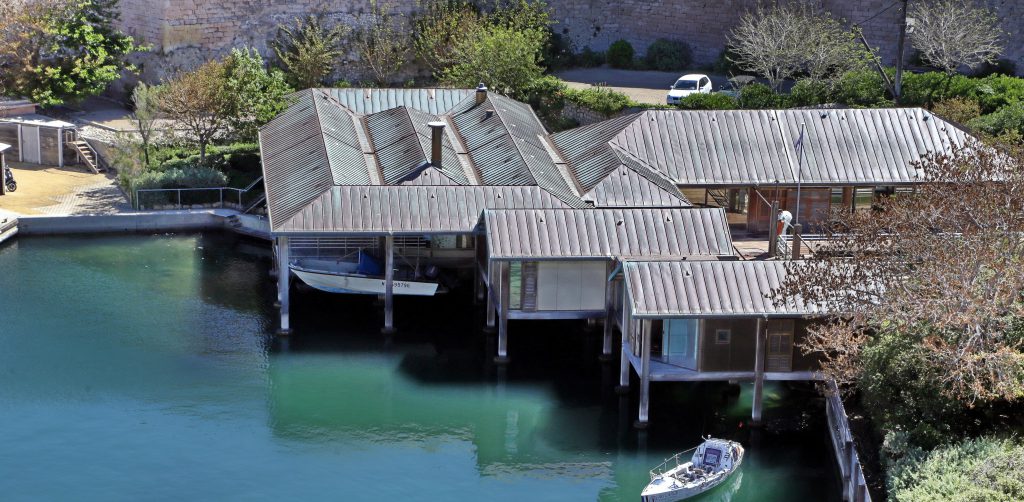
By the late 1970s, architectural boldness also meant starting with a wooden frame, building half of the usable surface not on solid ground but above the water, covering the roof of the house with copper plates, and installing a bathroom in a veranda opening onto the swimming pool and the vast garden. “In the early days, when the project still included offices,” recalls Harald Sylvander, “we did not choose to build part of the house on stilts simply for the pleasure of being above the water, but because Henri Delauze wanted to make the best possible use of the garden and optimise the space between the offices, which were to be built against the boulevard wall, and the house, positioned as close to the sea as possible.”
Once the office component was abandoned, the idea of a house suspended one metre above the waters of the Old Port remained, for the beauty of the gesture and for Henri’s pride.
Natural wood and copper roof
“As for the wood,” explains the architect, “our choice fell on iroko, which is rot-proof, withstands exposure to seawater very well, and requires no specific treatment—neither oil nor varnish.”
Before construction could begin, however, a building permit was required—one that Gaston Defferre granted without hesitation—but above all, it was necessary to convince the Architect of the Buildings of France, who had a say in the design of the house given its location at the foot of Forts Ganteaume and Saint-Nicolas and facing Fort Saint-Jean. “We reached a compromise with her by committing to leave the wood visible in its natural state and by covering the roof with copper, which turns green as it oxidises,” recalls Sylvander, who had made every effort to blend the building as seamlessly as possible into the existing landscape. The same approach was taken with the private squash court, which ultimately replaced the office building at the rear of the plot, against the retaining wall of Boulevard Charles-Livon.
To bring his dream to life, the company’s founder spared no expense. He selected his contractors from among the finest specialists in Marseille, across all trades. For the structure and timber frame of the house, he chose Jean Morel, a Meilleur Ouvrier de France, who personally selected the finest iroko logs on the docks of Sète and Port-Saint-Louis-du-Rhône. For the masonry work, the Chagnaud company was commissioned to carry out all the solid construction elements, starting with the piers supporting the stilts, largely poured beneath the sea.
As for the interior fittings and decoration, they were entrusted to Bernard Jourdeneaud, whom the Delauze family had already called upon a few years earlier for their apartment at the end of Quai de Rive-Neuve, at the far end of the Old Port.
The construction work lasted a little over 18 months, beginning at the end of 1979.

Of all the challenges Harald Sylvander faced throughout this construction project, the most perilous without a doubt remained the installation of the 17th-century Dutch bronze cannon—a majestic piece that Henri had legally brought back from an underwater excavation campaign organised near the island of Saint Helena, the very place where Napoleon Bonaparte would later die.
In 1978, together with his companion Robert Stenuit, a renowned shipwreck hunter, he had in fact rediscovered the Witte Leuwe (White Lion in Dutch), a 700-ton vessel sunk in 1613 by a Portuguese armada, not far from the small island where the fallen emperor would be exiled two centuries later. Given its size and weight, it was impossible to treat it as a simple piece of furniture.
“We had to build reinforced concrete foundations at its future location, which had been defined in advance,” the architect explains. He recounts that it was brought in through the roof using a crane, before the full installation of the framework and roofing. “If we wanted to remove it today, we would be facing a real problem,” he admits. Rest assured: no one has ever imagined moving this cannon one day.
Outside, the approximately 6,000 m² of open space has, from the very beginning, been home to a magnificent garden, designed with the ambition of concealing the entire property behind a dense curtain of vegetation.
A refuge for family and friends
The family finally moved in in April 1981, at a time when Comex was still enjoying sound economic health. During the first few years, Henri ultimately spent little time there, busy as he was managing the projects and operations the company was conducting across the globe.
Three years later, the oil and offshore markets took another downturn, and Saint-Nicolas became more than ever his refuge. When he was there, Philbée watched over him and over the house with care and discipline. “If he returned from a trip and went to bed to recover from jet lag,” Michèle Fructus would fondly recall, “my mother imposed absolute silence throughout the house, and anyone who dared disobey by making the floorboards creak immediately received a murderous look and a finger pointing toward the door.”
Ten years after fully taking possession of the property, Henri and Philbée experienced from Saint-Nicolas the most painful period in Comex’s history, the one that would lead to the sale of the company to the Norwegian group Stolt. Although still a world leader in its field, with rising revenues and solid profitability, Comex’s results were weighed down by financial costs linked to its debt. Despite his efforts throughout the 1980s, Henri-Germain Delauze was unable to restructure the company’s capital in a satisfactory way and was ultimately forced to relinquish its independence.

Between 1990 and 1991, a rapprochement was considered—first with Cogema, a subsidiary of the French Atomic Energy Commission (CEA), then with Coflexip, another major French player in the offshore oil and gas sector. But it was from Norway that the best—or least bad—offer arrived, and it was on a Sunday in March 1992 that Henri and Philbée decided to accept it. The transaction was finalised in June of the same year.
Comex Services, which generated more than 80% of the group’s turnover, came under the control of Jacob Stolt-Nielsen, who renamed it Stolt Comex Seaway. In Marseille, only Comex SA remained, along with the historic site on Boulevard des Océans and the Comex Pro division. The company thus once again became an SME, refocusing on oceanography, bespoke underwater services, the manufacture of hyperbaric chambers, and the creation of Comex Nucléaire, later sold to the Onet Group.
From that point on, Henri’s stays at the company’s headquarters became less frequent. He first began managing his teams from his office at Saint-Nicolas, then gradually handed over responsibility to his daughter, Michèle Fructus, who definitively took the helm of Comex SA in the early 2000s. The house already offered him everything he needed: he was surrounded by his wife and family, friends were always welcome, and he could embark at will on the Minibex, for which Harald Sylvander had designed a spacious and comfortable cabin—provided the mission at hand interested him, which was often the case.

In search of sunken treasures
Throughout the 1990s, and until his passing in February 2012, it was still from this small office over the water at Casa Delauze that he imagined and directed the operations for which his enthusiasm remained that of a young man—namely treasure hunts and the search for, and discovery of, forgotten shipwrecks.
He grew increasingly close to the Department of Underwater and Subaquatic Archaeological Research (DRASSM), the operational arm of the French Ministry of Culture for this type of work, which at the time was based opposite Saint-Nicolas, in the only part of Fort Saint-Jean still standing after the Second World War. Aware of the limited budgets allocated by the State for its research and of the obsolescence of its support vessel—the antiquated Archéonaute, commissioned in 1967—the director at the time, Patrick Grandjean, welcomed Delauze, his passions, his Minibex, and his resources with open arms.
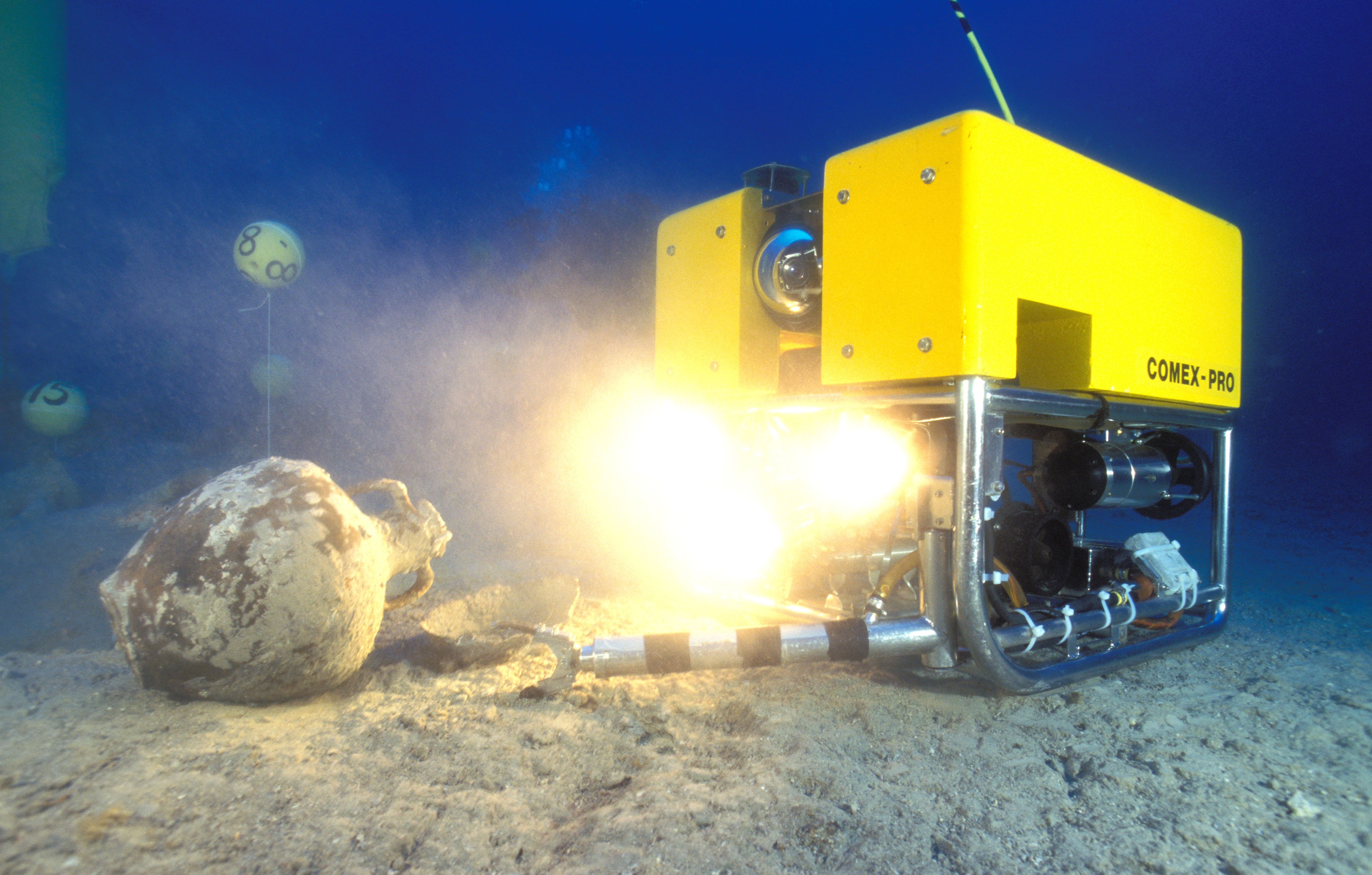
Together, they notably organised an experimental campaign on a Roman shipwreck off Cap Caveaux, in the Frioul archipelago, to validate new procedures and equipment designed in Comex workshops, with the aim of excavating a wreck—in the archaeological sense of the term—without any human intervention. On this occasion, Henri tested his new toy, Remora 2000, a unique two-seater submersible capable of diving to depths of over 600 metres in complete autonomy and of handling objects recovered from the seabed using its suction device and articulated arm.



The shadow of Saint-Exupéry
Three years later, in 1998, the last great adventure that would truly captivate him came knocking at the door of his small office at Saint-Nicolas one September morning. The evening before, the president of the local fisheries committee, Jean-Claude Bianco, had called him. He told him that earlier that same morning, he had hauled up in his trawl a small silver bracelet engraved with the name of Antoine de Saint-Exupéry, the famous writer and aviator, who disappeared at the controls of his Lockheed Lightning on 31 July 1944 during a wartime mission between Corsica, where his squadron was stationed, and the Alps, where he was to carry out photographic reconnaissance in preparation for the Allied landings in Provence, scheduled two weeks later.
Delauze was well aware of this story. In 1992, while he was negotiating the sale of Comex Services, he had in fact been contacted by the Louis Roederer champagne foundation, which wished to finance a research campaign to locate this mythical wreck, with the cooperation of Saint-Exupéry’s former comrades, starting with his squadron leader, General René Gavoille. With a heavy heart, he nevertheless declined the offer, as the team assembled by Roederer was then convinced—based on post-war testimonies—that the aircraft lay off the coast of Nice and Monaco, where depths quickly exceed 1,000 metres, a depth that only Ifremer could reach at the time using robotic vehicles. Two years of effort and expenditure would have been in vain, a fact Jean-Claude Bianco had just inadvertently confirmed, since Saint-Exupéry had clearly not crashed off the French Riviera, but indeed off the coast of Marseille, where no one had ever thought to look until then.

Three years later, in 1998, the last great adventure that would truly captivate him came knocking at the door of his small office at Saint-Nicolas one September morning. The evening before, the president of the local fisheries committee, Jean-Claude Bianco, had called him. He told him that earlier that same morning, he had hauled up in his trawl a small silver bracelet engraved with the name of Antoine de Saint-Exupéry, the famous writer and aviator, who disappeared at the controls of his Lockheed Lightning on 31 July 1944 during a wartime mission between Corsica, where his squadron was stationed, and the Alps, where he was to carry out photographic reconnaissance in preparation for the Allied landings in Provence, scheduled two weeks later.

Instead of the few days or weeks initially imagined, it ultimately took six long years for this investigation to come to fruition, for the remains of Saint-Exupéry’s Lightning to be found, and for the circumstances of his disappearance to be clarified. But to his great dismay, it was not Henri-Germain Delauze but a professional diver from Marseille, Luc Vanrell, who discovered the first traces of the Lightning in late 1999.
A further four years were then required to break through the obstacles immediately put in place by the Saint-Exupéry heirs to prevent the research, and to calm the fervour of a few agitators who, without a shred of evidence, accused Bianco and Delauze of having engraved the bracelet themselves in their kitchen to seek attention—as if either of them had needed that to exist.
After months of struggle, it was nevertheless Henri, and he alone, who obtained authorisation from the maritime prefect to raise to the surface the elements discovered by Luc Vanrell. It was also he who brought them aboard the Minibex in September 2003, before entrusting them to expert historians, who would ultimately validate the discovery in April 2004.
In its wake, this undeniably fascinating affair greatly occupied the few privileged individuals who frequented Casa Delauze regularly at the time. Dozens of meetings and discussions were held there to steer the research and attempt to unravel what was then still one of the last great mysteries of the Second World War. The happy conclusion certainly brought Henri some peace, but it did not extinguish his passion for the search for lost shipwrecks.
No sooner had Saint-Exupéry’s Lightning been found than he embarked on a new quest: that of the battleship Roma, flagship of the Italian fleet during the war years, before being sunk by its former German “allies” in 1943 off the coast of Sardinia. A search that would keep him engrossed until his final days (2), even though the summer of 2008 would mark a major turning point in his life.
In August of that year, while sailing off the coast of Corsica, in waters he never tired of exploring, Henri was in fact the victim of yet another unfortunate diving accident—the umpteenth in his life as a diver, but the first to leave him with significant after-effects. It was a rather harsh way to learn that at 78 years old, however fit one may be, the body no longer responds as well or as quickly as it did at 30, or even 50.


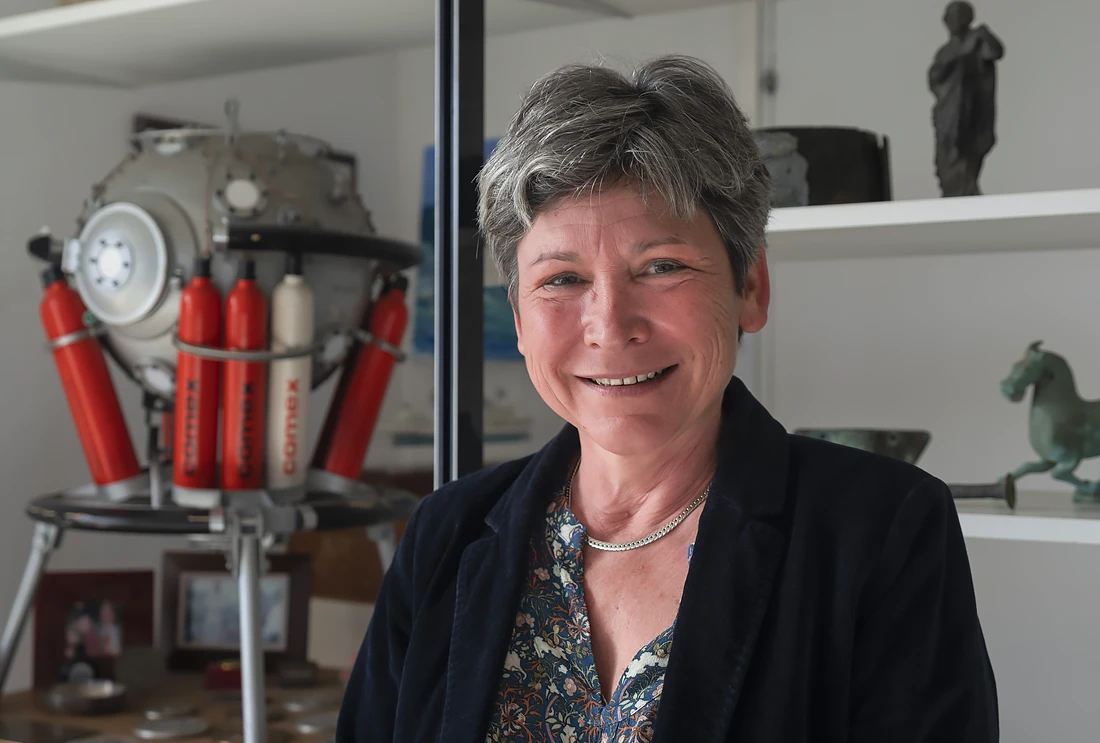
The company is still run by a woman, Alexandra Oppenheim Delauze, the daughter of Michèle Fructus, who chose to pay tribute to her grandparents and her mother by opening this magical place, a testament to their remarkable personal and professional success.
Hervé VAUDOIT.
(1) Henri-Germain Delauze was the youngest member of his graduating class. Among his fellow Gadz’arts (the nickname given to Arts & Métiers engineers), he would keep for the rest of his life the nickname inherited from that time: Benjam’s.
(2) Until 14 February 2012, the date of his passing.